Skip to Content
EduManara
  • Home
  • Courses
  • Contact us
  • Sign in
  • Contact Us
EduManara
      • Home
      • Courses
      • Contact us
    • Sign in
    • Contact Us
    1. Courses
    2. Engineering Design
    Nav
    Home └Engineering Design
    Engineering Design

    Engineering Design

    Love working with your hands more than with your ears? This class is all about hands-on learning! From designing robots to building bridges and skyscrapers, you’ll get to create real-world engineering solutions and see your ideas come to life.
    Start this Course
    Responsible Andy Hakim
    Last Update 05/07/2025
    Completion Time 9 minutes
    Members 2
    • ​ Course
    Filter & order
    • Video 3
    • Order by : Most Viewed
      Sort by
      Newest Most Voted Most Viewed
    Grade 9 Elective
    Hydraulics | GCSE Physics | Doodle Science
    Hydraulics | GCSE Physics | Doodle Science

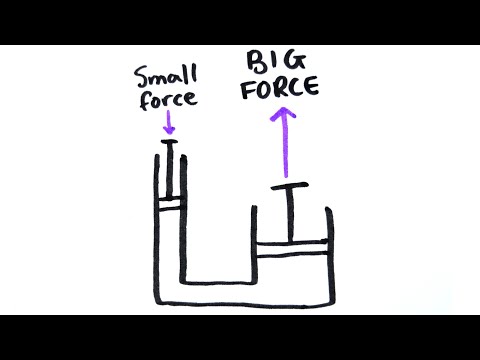
    Key Concept: Hydraulics as Force Multipliers

    Hydraulics may sound complicated, but they’re essentially force multipliers. They work because:

    • Liquids are virtually incompressible.
    • When you apply pressure to a liquid, it is transmitted equally in all directions.

    Analogy:

    Think of a balloon with holes. Squeeze the top, and water squirts out of all holes — showing how the pressure is shared throughout the liquid.

    Important Formula

    Pressure (P)=Force (F)Cross-sectional Area (A)\text{Pressure (P)} = \frac{\text{Force (F)}}{\text{Cross-sectional Area (A)}}Pressure (P)=Cross-sectional Area (A)Force (F)​

    • Pressure → measured in Pascals (Pa)
    • Force → measured in Newtons (N)
    • Area → measured in square metres (m²)

    Hydraulic System Example

    • Input piston area: 0.001 m²
    • Force applied: 15 N
    • Pressure generated: P=150.001=15,000 PaP = \frac{15}{0.001} = 15{,}000 \text{ Pa}P=0.00115​=15,000 Pa
    • Output piston area: 0.01 m²
    • Force output: F=P×A=15,000×0.01=150 NF = P \times A = 15{,}000 \times 0.01 = 150 \text{ N}F=P×A=15,000×0.01=150 N

    So, a small force on a small piston creates a larger force on a larger piston — this is how hydraulic multipliers work!

    Real-Life Applications

    • Car braking systems
    • Car jacks
    • Aircraft landing gear

    These systems allow small effort forces to generate large output forces, making heavy tasks easier — like changing a tyre!

    References:

    1. BBC Bitesize – GCSE Physics
    2. CGP GCSE Physics AQA Revision Guide
    Academic
    Academic
    View all
    Hydraulics | GCSE Physics | Doodle Science
    Hydraulics | GCSE Physics | Doodle Science
    Preview

    Key Concept: Hydraulics as Force Multipliers

    Hydraulics may sound complicated, but they’re essentially force multipliers. They work because:

    • Liquids are virtually incompressible.
    • When you apply pressure to a liquid, it is transmitted equally in all directions.

    Analogy:

    Think of a balloon with holes. Squeeze the top, and water squirts out of all holes — showing how the pressure is shared throughout the liquid.

    Important Formula

    Pressure (P)=Force (F)Cross-sectional Area (A)\text{Pressure (P)} = \frac{\text{Force (F)}}{\text{Cross-sectional Area (A)}}Pressure (P)=Cross-sectional Area (A)Force (F)​

    • Pressure → measured in Pascals (Pa)
    • Force → measured in Newtons (N)
    • Area → measured in square metres (m²)

    Hydraulic System Example

    • Input piston area: 0.001 m²
    • Force applied: 15 N
    • Pressure generated: P=150.001=15,000 PaP = \frac{15}{0.001} = 15{,}000 \text{ Pa}P=0.00115​=15,000 Pa
    • Output piston area: 0.01 m²
    • Force output: F=P×A=15,000×0.01=150 NF = P \times A = 15{,}000 \times 0.01 = 150 \text{ N}F=P×A=15,000×0.01=150 N

    So, a small force on a small piston creates a larger force on a larger piston — this is how hydraulic multipliers work!

    Real-Life Applications

    • Car braking systems
    • Car jacks
    • Aircraft landing gear

    These systems allow small effort forces to generate large output forces, making heavy tasks easier — like changing a tyre!

    References:

    1. BBC Bitesize – GCSE Physics
    2. CGP GCSE Physics AQA Revision Guide
    Academic
    00:02
    0 0
    Arduino in 100 Seconds
    Arduino in 100 Seconds
    Preview
    Arduino is a programmable circuit board that makes it possible for the average developer to build custom hardware products. Learn about Arduino's architecture, microcontroller, programming language, and IDE in 100 seconds. Look below for extra resources for a complete Arduino Crash Course.
    Academic
    00:02
    0 0
    Scratch Basics - A Beginners Guide to Scratch
    Scratch Basics - A Beginners Guide to Scratch
    Preview
    *Learn how to get started with Scratch* in this beginners guide. Covering both the online & offline editors, how to register for an account, an overview of the Scratch Editor & workspace, and a quick how to guide on Creating and sharing your first Scratch Game! 🚀 Scratch was developed by the Lifelong Kindergarten Group at the MIT Media Lab. See http://scratch.mit.edu *Chapters* 0:00 Introduction 0:29 Step 1: The Scratch Website 0:45 Step 2: The Scratch Community 1:12 Step 3: Joining Scratch or using Scratch Offline 1:59 Step 4: The Scratch Editor 2:32 Step 5: Creating Your First Project 3:41 Step 6: Saving and Sharing in the Scratch Online Editor 4:33 Step 6b: Saving in the Scratch Offline Editor 4:50 Griffpatch Academy
    Academic
    00:05
    0 0

    Designed for each Manara students

    We are a team of passionate people whose goal is to improve everyone's life through creating a collective knowledge pool. 

    EduManara
    Mohamed Ibrahim Kamel St, Hurghada 2, Red Sea Governorate 84513 
    Egypt


    • ahakim28@manaraschool.org
    Follow us
    Click here to setup your social networks
    Copyright © EduManara
    Powered by Odoo - Create a free website